
Reviewed · GLASGOW GHOST WALKS & DARK HISTORY
Glasgow Ghost Hunt: The Soul That Got Away Exploration Game
Glasgow gets spooky without a guide. This smartphone-led ghost hunt turns classic city sights into an interactive, clue-by-clue walk across Glasgow’s center. You follow prompts on your phone, answer questions as you go, and end up with a neat mini tour of landmarks that most people never connect into one route.
I especially like the app-led directions that help you not get lost, even when you’re bouncing between big streets and side corners. I also like the flexible pacing, so you can start when you want, pause if you need a breather, and keep going when you’re ready.
One thing to watch: the experience depends on the app working smoothly. If signing in or the location prompts get glitchy, you can lose time fast, and a few people reported giving up when the clues didn’t feel solvable.
In This Review
- Key takeaways before you go
- Glasgow Ghost Hunt in 90 minutes: walking puzzles, not a scary show
- Glasgow Central: where the route starts and the first clue hides
- Lighthouse of Glasgow: design-and-architecture views plus a not-so-light secret
- House of Frasers: shopping streets with a 19th-century origin story
- Tron Theatre: culture landmarks with a move-and-answer puzzle vibe
- Merchant City square: tobacco-lord trade and the hunt’s “midnight marketplace” feel
- Buchanan Street: Andrew Buchanan’s name, modern pedestrian energy
- George Square and the City Chambers: Queen Victoria, Mandela, and statues you can’t miss
- The final checkpoint in George Square: King George III to Scottish legends
- Flexibility that actually helps: start/stop whenever your day allows
- Price and value at $6: what you get for the money
- Where it can go wrong: app sign-in, location prompts, and clue frustration
- Is it a true ghost hunt, or more city history with spooky seasoning?
- Who should book this Glasgow Ghost Hunt (and who should skip it)
- Should you book this Glasgow Ghost Hunt?
- FAQ
- How much does the Glasgow Ghost Hunt cost?
- How long does the experience take?
- Where does it start and where do I finish?
- Do I need a physical tour guide?
- Do I need entry tickets to attractions?
- Is the experience offered in English?
- Can I play it anytime after booking without rescheduling?
- What is the cancellation policy?
- What if my group is larger than 15 people?
Key takeaways before you go

- Start at Glasgow Central, finish near West George Street for an easy city-center route
- Smartphone app does the guiding, with directions you can follow between checkpoints
- No entry tickets needed to complete the game, since it’s built around public sights
- Open-air and self-guided so you can avoid crowds and move at your own speed
- Plan for about 1.5–2 hours, especially if you stop for photos or a quick drink
- Tech matters: bring a charged phone and expect the app to be the main “tour guide”
Glasgow Ghost Hunt in 90 minutes: walking puzzles, not a scary show
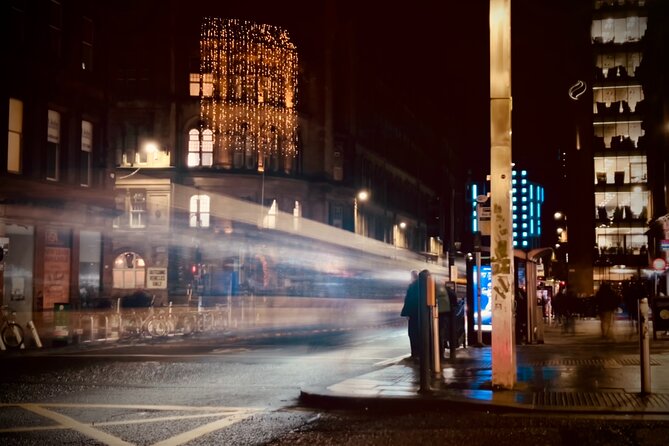
This isn’t a staged theatre ghost story. It’s more like a city walk you solve, checkpoint by checkpoint, using your phone as the guide. The ghost theme is part of the fun, but the backbone is sightseeing plus questions tied to what you’re standing in front of.
You’ll move through some of Glasgow’s most recognizable architecture and also through areas where you can stumble onto street art and festival-style energy. It’s self-guided, open air, and designed to help you dodge crowds because you’re not tied to a group moving on a schedule.
Cost-wise, at $6 per person, it’s the kind of activity that feels doable even on a tight trip. The big value point is that the app is included, and you don’t need to buy attraction entry tickets just to finish the route.
After dark: more ghost walks and grim history around Glasgow



Glasgow Central: where the route starts and the first clue hides
Your adventure kicks off at Glasgow Central (Gordon St), one of Scotland’s principal rail terminals. The station itself is a showpiece: a glass roof and classic Victorian architecture, and it’s also the busiest station from Scotland—so yes, you’ll feel people around you right away.
The game opens with an easy challenge right at the start. You’re prompted to look around and find a missing clue. There’s also a fun bit of backstory here: Glasgow Central used to be tied to underground vaults, catacombs, and disused platforms below the station, and the puzzle nudges you to notice details instead of rushing to the next stop.
Practical note: since this is app-led, you’ll want your phone ready before you begin. A charged battery helps, because the tour rhythm is “look, answer, move,” and there’s no human guide to slow things down when the app needs a second try.
Lighthouse of Glasgow: design-and-architecture views plus a not-so-light secret
Next, you walk to the Lighthouse of Glasgow, which is Scotland’s Centre for Design and Architecture. It’s the kind of place that makes sense for a mystery game: it’s actively about exhibitions and events, and the architecture has that “pay attention” feel.
You might expect sea views from a lighthouse, but this one is framed differently. From the route’s perspective, you get an uninterrupted sweep over Glasgow’s cityscape. That matters because puzzles work best when you can actually see the area the game wants you to notice.
Then comes the creepy hook: somewhere at the Lighthouse there’s a not-very-light secret, and you’re asked to check your surroundings to find it. It’s not just “read and move on.” The experience nudges you to look closely in the spaces you’re already standing in.
House of Frasers: shopping streets with a 19th-century origin story
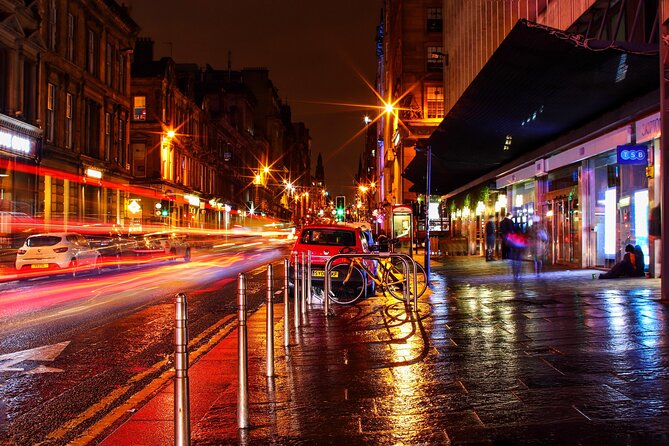
After the Lighthouse, the hunt pushes into shopping territory with House of Frasers, a major UK department store. The game gives you a quick historical anchor too: it started as a drapery store in Glasgow, founded by Hugh Fraser and James Arthur in 1849, then grew into a chain through acquisitions.
This stop is built around curiosity. You’ll walk around and answer a question tied to the idea of afterlife tastes—so the ghost theme shows up as wordplay and prompts rather than jump-scares. One nice aspect here is that you can treat it like a normal shopping break, then snap back into puzzle mode when the app tells you to move.
One caution from real-world use: the map for a checkpoint tied to a “peacock” moment may send you to the wrong side of the building. If you hit a mismatch, don’t panic—just confirm what the prompt is asking you to look for at the correct frontage, then proceed.
Tron Theatre: culture landmarks with a move-and-answer puzzle vibe
The route’s mid-point swings toward the Tron Theatre, a longtime player in Glasgow’s cultural scene for over twenty years. It started as a theatre club and grew into a multi-activity venue that’s known for new writing plus performance styles like dance, comedy, and music.
The game’s prompt at this stop is physical in tone. You’re told to warm up your voice and prepare your moves, then “dance” through the surroundings of the Tron Theatre to rise to the challenge and advance.
In practice, that can mean you’ll walk the area slowly, look at your surroundings like you’re staging your own tiny performance, and answer what the app asks. It’s a playful break from the pure history angle, and it also helps keep the energy up if the weather turns.
Fancy a puzzle? More escape rooms and city games in Glasgow
- Watch Closely – An Evening of Magic★ 5.0 · 75 reviews
- Glasgow Ghost Hunt: The Soul That Got Away Exploration Game★ 4.0 · 71 reviews
- A Silent Disco Adventure in Glasgow★ 5.0 · 43 reviews
- Glasgow: Silent Disco Adventure Tour★ 5.0 · 31 reviews
- The Ghost of Mary Queen of Scots Escape Room★ 5.0 · 24 reviews
Merchant City square: tobacco-lord trade and the hunt’s “midnight marketplace” feel
After theatre, you step into an older Glasgow mood at the Merchant City side of things. The game frames this as the middle of the 1750s, with residents trading with merchant tobacco lords who profited from shipping and selling tobacco, sugar, and tea.
What I like about this stop is that it doesn’t just throw facts at you. It encourages you to scan the square and find “unspoken truths,” which is a better way to learn than reading a plaque and moving on.
Today, Merchant City is also described as having a renaissance: bars, restaurants, boutiques, galleries, and frequent festivals with street arts, dance, comedy, and live music. For your tour experience, that means the area is often visually interesting, so your phone prompts feel less like paperwork and more like a scavenger hunt through real street life.
Buchanan Street: Andrew Buchanan’s name, modern pedestrian energy
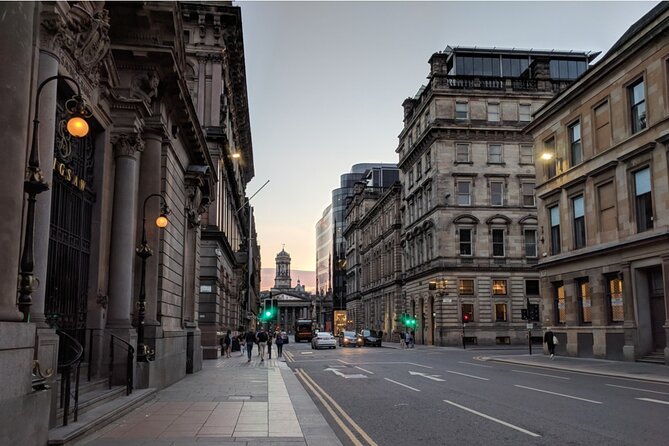
From Merchant City, the route heads to Buchanan Street, Glasgow’s main pedestrian boulevard. The game’s history note is specific: it was inaugurated in 1777 and named after Andrew Buchanan, a wealthy tobacco lord tied to this area.
The game also points out a key arc: Buchanan lost his propriety, and the street became one of Glasgow’s famous shopping districts anyway. That’s a useful context clue because it explains why you’re walking a street that feels refined and commercial, not medieval or industrial.
You’ll likely notice the atmosphere right away: upmarket shops, places to eat, and street artists mixing into the scene. The app uses this stop to ask you questions and draw out surprising facts, so it’s a good moment to slow down and actually read your surroundings instead of speed-walking.
George Square and the City Chambers: Queen Victoria, Mandela, and statues you can’t miss
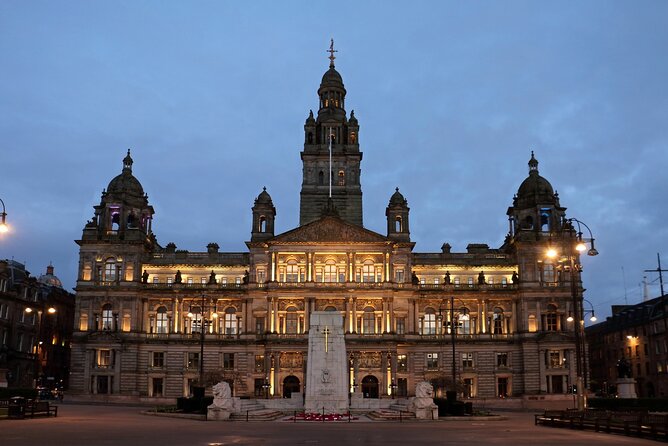
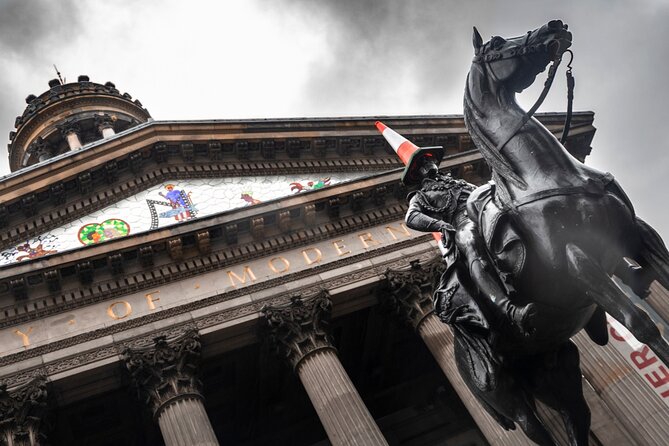
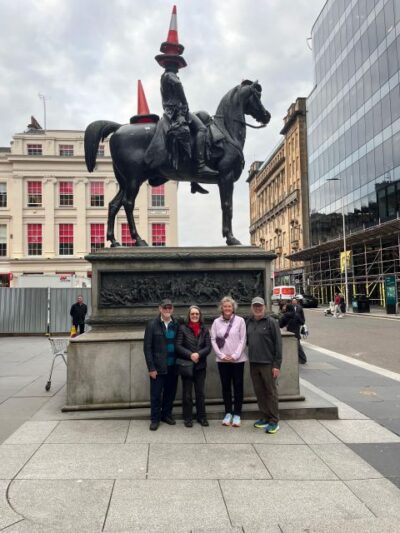
Now you’re in the big-sight zone: George Square, and the City Chambers of Glasgow. The game notes that it was inaugurated by Queen Victoria in 1888, and when you enter, you’re greeted by Queen Victoria herself in statue form, locally nicknamed Glasgow’s own Statue of Liberty.
Clue time here is tied to the space. You’re directed up the largest marble staircase in Western Europe, then toward the Banqueting Hall—where Nelson Mandela received his Freedom of the City award in 1993. Even if you’re not thinking about ghosts, this is the kind of landmark that gives the hunt real weight.
Then it’s onward to the final challenge. You’ll keep walking inside the George Square area, solve a challenge to reach your destination, and finish at George Square itself, the city’s most well-loved civic square.
The final checkpoint in George Square: King George III to Scottish legends
Your last part is all about monuments and names. George Square is described as named after King George III, and it features an important collection of statues including figures like Robert Burns, James Watt, Sir Robert Peel, and Sir Walter Scott.
The game also gives a fun origin detail: it began as a muddy hollow and later became a major attraction. That’s a good closing line because it makes the square feel earned—like the route has moved you from modern streets and storefronts to a place that tells Glasgow’s story in stone.
This ending works well if you want a “last moment” payoff where the walk feels complete. It’s also a natural spot to pause, grab a drink nearby, and plan what you want to see next in Glasgow now that you’ve already covered the center.
Flexibility that actually helps: start/stop whenever your day allows
This is built to fit your schedule. After booking, you can play it anytime without needing to reschedule, and you can start, take a break, and continue at your own pace. It also runs on a daily basis throughout the day, with opening hours listed as 12:00 AM to 11:59 PM.
In real terms, that flexibility matters because Glasgow weather can change the mood in minutes. Since the hunt is open air and mostly a walk, rain can cut the session short—one player even reported heavy rain stopping the game early. If the forecast looks iffy, pack a small rain layer and keep moving toward covered areas when needed.
Time-wise, the listed duration is about 1 hour 30 minutes, but I’d treat that as a baseline. Some people took around two hours, and adding a pub stop is easy since you’re crossing major districts with lots of breaks built into the route.
Price and value at $6: what you get for the money
At $6 per person, the value depends on one thing: how much you like self-guided puzzle walking. If that’s your style, you’re getting a lot in one go—multiple major sites, a route that ties them together, and the app that handles the “where to next” part.
The tour also avoids a common cost trap: you don’t need entry tickets for attractions to complete the game. That means you can spend the money you planned, keep control of your budget, and still get a satisfying loop through the city.
You’ll also have a private setup for your group, and there are group discounts. If you’re booking for more than fifteen people, you’ll need multiple bookings, but for most groups this is straightforward.
All that makes it one of those “cheap but smart” options for a first-time visitor who wants structure without committing to a full guided day.
Where it can go wrong: app sign-in, location prompts, and clue frustration
This experience lives or dies by the app. A handful of people reported that signing in was a chore, that the app upload felt tricky, and that location-based play created frustration when they couldn’t progress. One person described it as unresolvable after the clues felt too difficult.
There are also small accuracy and logic issues to be aware of. Someone reported that an answer marked incorrect when they believed it was correct, and another noted the map routed them to the back of House of Frasers instead of the front for a checkpoint involving a peacock-related moment.
My advice: before you start, do a quick check. Make sure the app can log you in, confirm you understand what it wants you to locate at the first stop, and keep enough battery for a full hour plus. If something goes off-track, don’t burn time guessing—contact support using the email shown in the company’s responses ([email protected] or [email protected]) so you don’t waste the rest of your walk.
If you’re traveling with a tight schedule, keep a little buffer. A tech hiccup isn’t a deal-breaker, but it can ruin the fun if you don’t have wiggle room.
Is it a true ghost hunt, or more city history with spooky seasoning?
The “ghost hunt” label is real, but the experience leans heavily on city history and architecture. That’s why it works so well for people who enjoy learning through playful prompts rather than intense scares.
The good news: the puzzles have been described as fun and even appropriate for kids—one family said a ten-year-old loved the riddles. The experience has also been called thoughtful and informative, with a ghost story element that keeps the route intriguing.
The trade-off: if you’re expecting lots of ghost stories at every stop, you might feel it’s lighter on hauntings and heavier on location history. That’s the right expectation to set ahead of time. You’re solving questions while moving through real Glasgow landmarks, and the ghost side is part theme, not the entire show.
A memorable moment is also part of the appeal. One player shared a striking highlight: a haunting shadow of a lady on the wall opposite the Scotia. Even if you’re not “ghost-hunting” in the traditional sense, those kinds of moments can make the route feel special.
Who should book this Glasgow Ghost Hunt (and who should skip it)
Book it if you want a low-cost, structured walking route and you like puzzle formats that keep you focused. It’s a strong choice for couples and families because the pace is flexible, and the app takes care of the next step.
You should also consider it if you like seeing parts of the city you wouldn’t otherwise connect—especially the Merchant City and George Square area, plus the theatre zone near the Tron Theatre. The game’s route encourages that kind of accidental discovery, like street art moments and less-obvious angles of famous spots.
Skip it if you need a human guide. There’s no physical tour guide here, and if you’re worried about app reliability, you may prefer a classic tour with a person leading the story. Also skip if your idea of a ghost hunt is nonstop scary narratives; this is more of a guided-by-phone mystery walk with history threaded through.
Should you book this Glasgow Ghost Hunt?
I think it’s worth booking if you want an affordable way to cover serious Glasgow sights without paying for entry tickets and without committing to a fixed tour time. The app-led navigation and start/stop flexibility make it easy to fit into your day, and the route connects landmarks in a way that feels like sightseeing with a purpose.
But do it with one clear condition: bring patience for the phone part. If you’re tech-comfortable and you charge your device before you go, this can turn a simple walk into a memorable, puzzle-driven Glasgow evening.
FAQ
How much does the Glasgow Ghost Hunt cost?
It costs $6.00 per person.
How long does the experience take?
It takes about 1 hour 30 minutes.
Where does it start and where do I finish?
It starts at Glasgow Central, Gordon St, Glasgow G1 3SL, UK, and ends at West George Street, Glasgow G1 2AF, UK.
Do I need a physical tour guide?
No. This is self-guided, and there is no physical tour guide.
Do I need entry tickets to attractions?
No. Entry tickets are not needed to complete the tour.
Is the experience offered in English?
Yes, it’s offered in English.
Can I play it anytime after booking without rescheduling?
Yes. You can play it anytime after booking without rescheduling, and you can start, take a break, and continue at your own pace.
What is the cancellation policy?
Free cancellation is available. You can cancel up to 24 hours in advance for a full refund, and cancellations within 24 hours do not receive a refund.
What if my group is larger than 15 people?
If your group is larger than 15 people, you can make multiple bookings.
More Escape Rooms & City Games in Glasgow
- Watch Closely – An Evening of Magic
★ 5.0 · 75 reviews - Glasgow: Haunted Quest Experience
★ 3.7 · 57 reviews - A Silent Disco Adventure in Glasgow
★ 5.0 · 43 reviews - Glasgow: Silent Disco Adventure Tour
★ 5.0 · 31 reviews - The Ghost of Mary Queen of Scots Escape Room
★ 5.0 · 24 reviews
More Ghost Walks & Dark History in Glasgow
- Glasgow: Ghouls, Ghosts & Gruesome Tales Guided Walking Tour
★ 4.9 · 887 reviews - Gothic Glasgow Walking Tour
★ 5.0 · 448 reviews - From Glasgow: The Devil’s Pulpit Day Trip
★ 4.4 · 94 reviews - Glasgow: Haunted Quest Experience
★ 3.7 · 57 reviews - The Dark Side of Glasgow
★ 5.0 · 41 reviews
More Tour Reviews in Glasgow
- Glasgow: Celtic Park Stadium Tour
★ 4.9 · 3,336 reviews - Guided Celtic Park Stadium Tour
★ 5.0 · 3,136 reviews - Glasgow: City Sightseeing Hop-On Hop-Off Bus Tour
★ 4.5 · 3,095 reviews - From Glasgow: Oban, Glencoe, Highland Lochs & Castles Tour
★ 4.9 · 2,123 reviews - City Sightseeing Glasgow Hop-On Hop-Off Bus Tour
★ 4.5 · 1,873 reviews
Still browsing? A handful of other Glasgow trips worth a place on the list




Glasgow Ghost Walks & Dark History, compared.
 ★ 4.9Ghouls, Ghosts & Gruesome Tales Guided Walking TourFrom $22887 reviews
 ★ 5.0Gothic Glasgow Walking TourFrom $19448 reviews
 ★ 4.4The Devil’s Pulpit Day TripFrom $12194 reviews
 ★ 3.7Haunted Quest ExperienceFrom $857 reviews
 ★ 5.0The Dark Side of GlasgowFrom $3741 reviews
 ★ 5.0The Ghost of Mary Queen of Scots Escape RoomFrom $3824 reviews
 ★ 5.0Escape Room The Ghost of Mary Queen of ScotsFrom $3719 reviews
 ★ 5.0The Dirty Day TourFrom $1,30015 reviews
Browse the lists this tour appears in